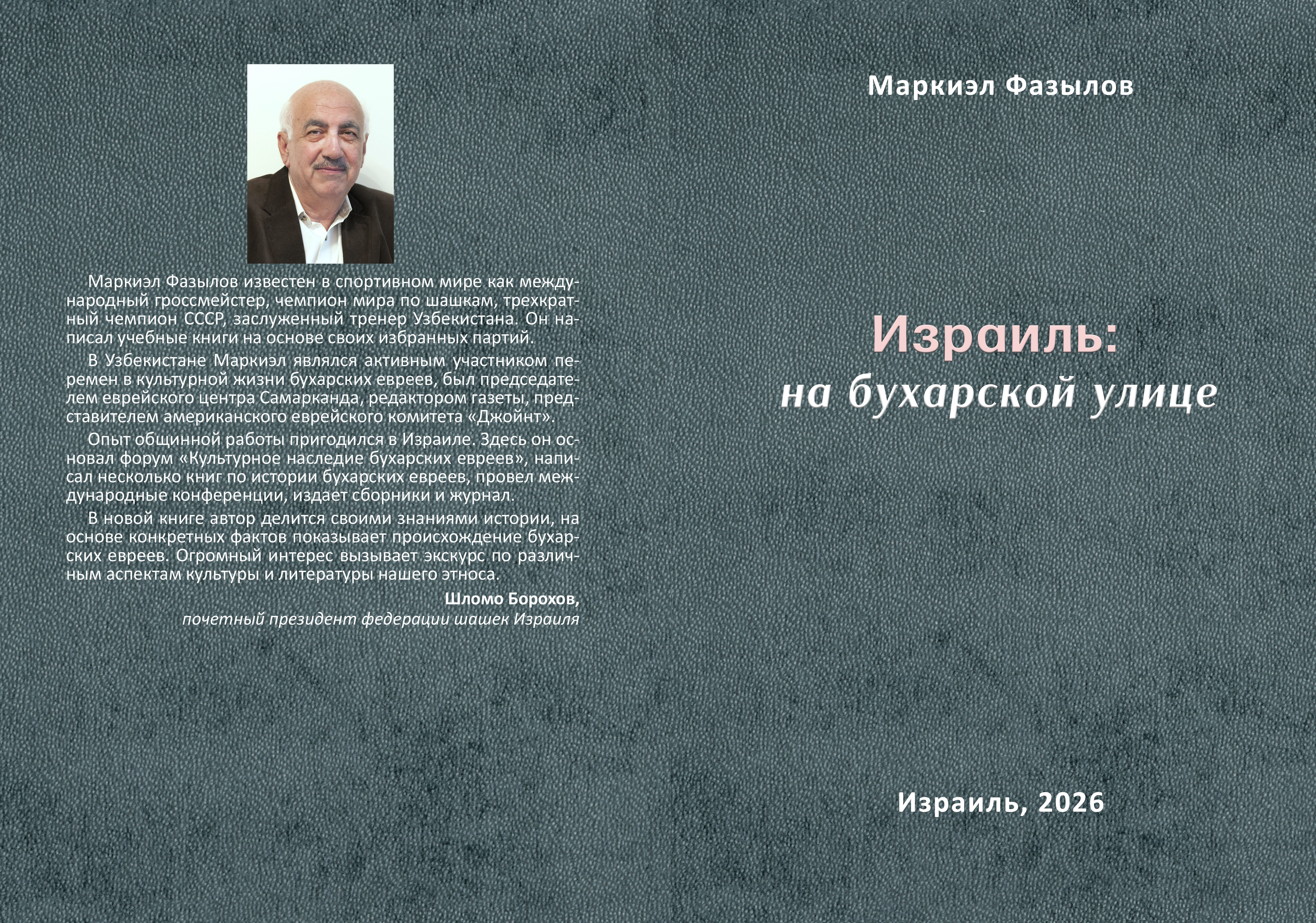
At the Tel Aviv office of the World Congress of Bukharian Jews, a presentation was held for Markiel Fazylov's new book Israel: On the Bukharian Street. Despite the wartime situation, the presentation drew several members of the Writers' Union of Israel and members of the forum "Cultural Heritage of Bukharian Jews."
The "Bukharian street" is not merely an address but a rich, evocative expression that encompasses the communal, religious, cultural, and political life of our people. What forms the foundation of this life? What are our unique cultural traits, and what today constitutes the self-identity of a Bukharian Jew? These questions call not only for emotional reflection but also for a deep, at times scholarly, approach.
The idea for this book came to the author many years ago, when a volume devoted to Israel's "Russian street" — the Ashkenazim from the republics of the former USSR — came into his hands. As the author himself puts it: "The time had come to write about the 'Bukharian street' — about the destinies and legacy of Jews who arrived in Israel from Central Asia. Yet at that moment I felt I had still to truly grasp the full depth of our history and culture."
The years following his repatriation became a time of painstaking labor. During this period, M. Fazylov published several books dedicated to the history of Bukharian Jews, to our writers, artists, and singers; he gathered under one cover the legends and folktales of the Bukharian Jews, and issued a book on the national cuisine and on the Jewish cemeteries of Central Asia. Every document studied, every biography of a distinguished countryman became a brick in the foundation for reflection on the past and present of our people. The result was two volumes of biographies titled My People.
Today we stand at a crossroads. Bukharian Jews are losing their native tongue, their literature, and their customs; even our outward appearance is changing. Young people relate in varied ways to the heritage of their fathers and mothers. Will they be able — and will they wish — to carry on the traditions of their ancestors? In an age when technological progress dictates new rules and artificial intelligence sometimes supplants the creative quest itself, this question rings with particular urgency.
M. Fazylov's book Israel: On the Bukharian Street calls not for a cursory reading but for serious reflection. It consists of eight chapters: "Bukharian Jews," "How Many of Us Are in the World," "Bukhara Through European Eyes," "Religion," "Culture," "Antisemitism," "Repatriation," and "Israel." In each chapter the author draws original conclusions on many aspects of our culture and literature, our history and religion.
In the preface, M. Fazylov writes: "My aim is to lay bare our roots, to show honestly the changes that have taken place and the prospects that lie ahead. Every reader, of course, will form his own view on the subjects raised — depending on his worldview, his degree of religious observance, or the keenness with which he perceives these problems. But I am confident: you will find in this book not only important historical facts but also food for thought about our achievements, our harsh realities, and those dreams that are yet to come true."
Summing up this study of the phenomenon of the "Bukharian street" in Israel, we see a unique example of the historical resilience of our people. The experience of Bukharian Jews in the Holy Land is a story of creation, in which fidelity to tradition became the foundation for social ascent. For many years, M. Fazylov has devoted himself to promoting the history of the Bukharian Jews and preserving the historical memory of the people. He closes the book with these words: "So long as the memory of our roots lives on, the future of the Bukharian Jewish community in Israel will be as bright and creative as its centuries-long history."