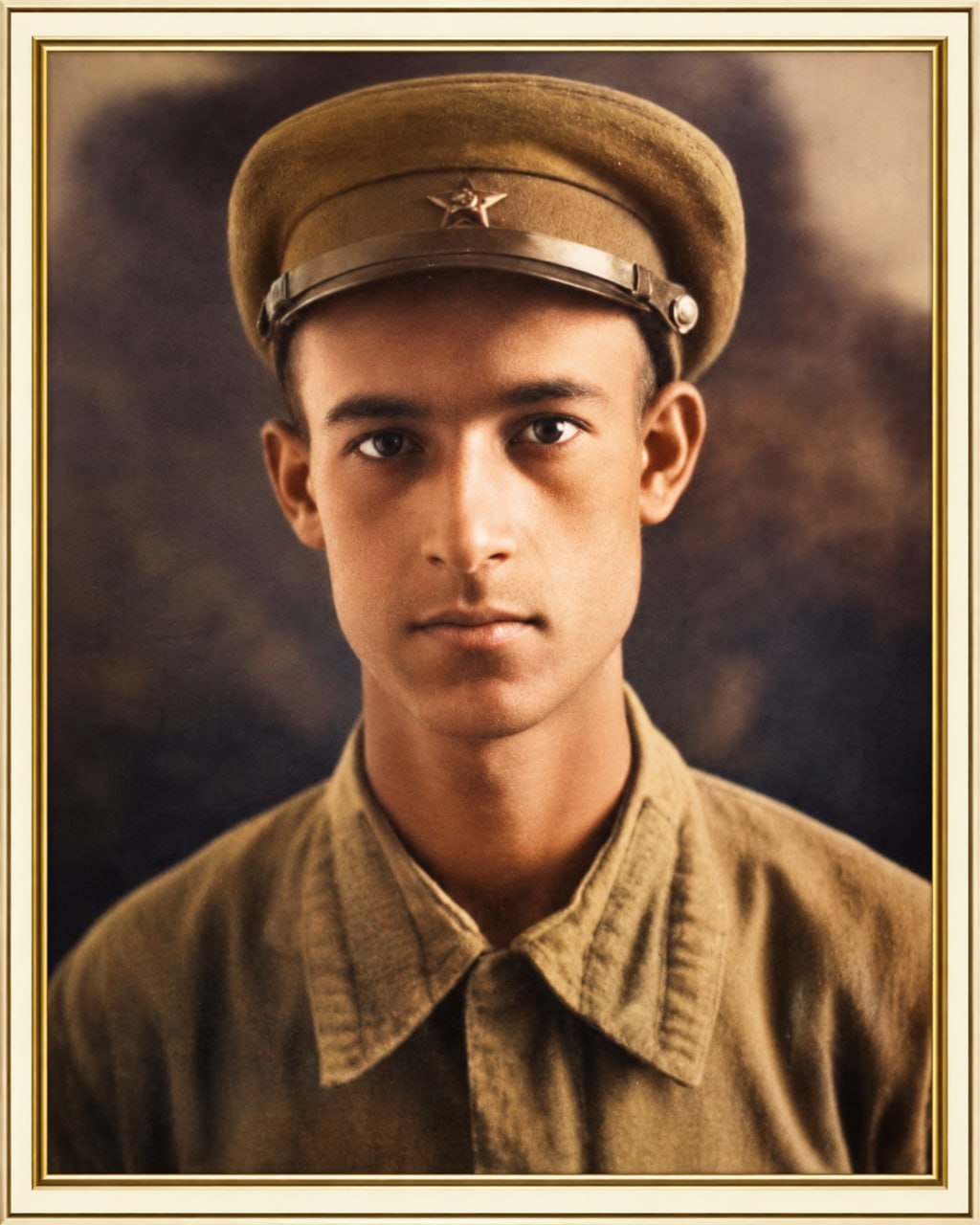
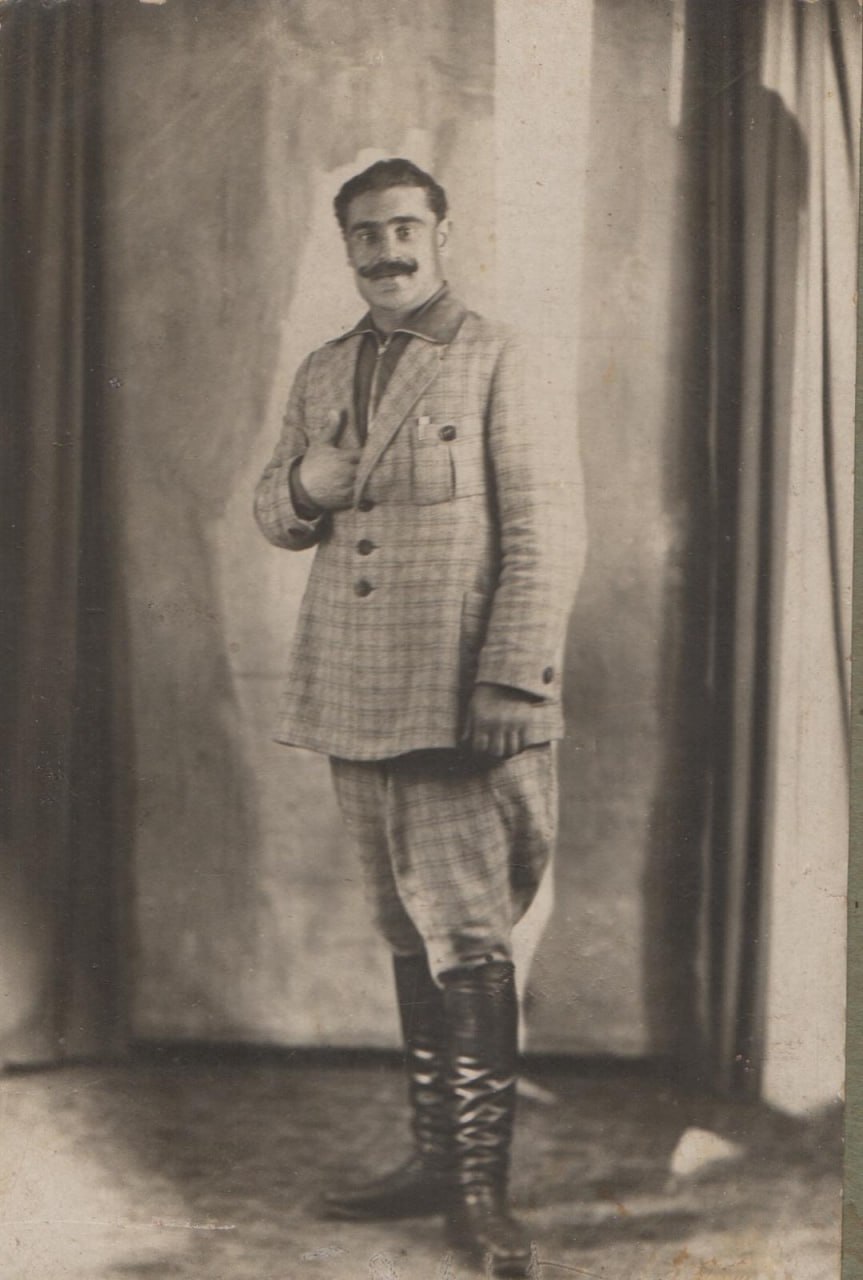
He was born in Samarkand into a religious family. His father Baruch belonged to the Pinhasov dynasty — a hereditary line of master fabric-dyers. The Muslim community called their great-grandfather «usto-Niyaz» (Master Niyaz), and from that came the family name Ustoniyazov. His mother Rachel came from the Baturov family. Before Rachel, Baruch had been married to Sorah Tahalova of Bukhara, who died in a typhus epidemic, leaving behind a son, Zion, and a daughter, Malko. Rachel bore Baruch two sons: Hananya and Neriah. As a boy Hananya attended the «khomlo» — the elementary religious school — growing up diligent, quick-witted and a pillar for his parents.
In the early 1920s, after the Basmachi pogrom in Kokand, refugees poured into Samarkand. Among them was the family of the wealthy Chaim ha-Kohen Aulov, who had been murdered in the pogrom. His wife Ester barely escaped with her young children. Thirteen-year-old Ksio (Bloriya) was soon orphaned and became Hananya's destined bride: they married in 1922. Hananya grew tall and strong; God gave him boundless physical strength. He was one of the four heroes of «Bogi Podshohi» — the celebrated masters of the «Kurash» wrestling — who protected their fellow Jews from the multi-ethnic surroundings. This is recorded in the diary of his brother Neriah.
Under Soviet rule Hananya finished driving school and joined the first cohort of young drivers in Samarkand. In 1929, when Dushanbe received city status and was renamed Stalinabad, Hananya moved there with his wife and two children to work in the rapidly developing republic. He soon became a foreman, then a fleet chief, and in 1934 the People's Commissariat of Transport appointed him head of a freight motor depot. Called up in 1941, he was pulled from the troop train at the last minute by a special order and sent as an instructor to a school training tractor and truck drivers for the front.
After the war Hananya returned to the faith of his fathers and became a deeply religious man. He left the driving trade — first running a silk-cocoon workshop, then a wooden-trunk workshop in the Surkhandarya region. In Termez he opened a building-materials store at the town bazaar next to the tea-house; Uzbeks and Tajiks adored him for his fluency in their languages, his poetic mind and his fearless conversations about the greatness of the Old Testament. In 1963 the atheist regime could not forgive his open religiosity — a fabricated case ended in a sentence «for shamanism, agitation to open a synagogue, and ideological corruption of Soviet youth». His eldest son Ilyauhaim filed an appeal, travelled to Moscow, and secured his father's early release.
Hananya returned to Dushanbe, then went to study at the yeshiva of the Arkhipov Street synagogue in Moscow, where he was ordained as a shohet (ritual slaughterer) and mohel. Every year he toured the Bukharan Jewish communities of Central Asia — Karshi, Shahrisabz, Termez, Dushanbe — slaughtering cattle and poultry and circumcising children. He took no money; donations, he asked, should go to the synagogue treasury for those in need. In 1970 he brought the first mechanical matzah machine from Moscow to Dushanbe. Witnesses recall that even when the press crushed his hand, he did not utter a single moan. He was a member of the twenty-man council of the Dushanbe community and, well into old age, never refused the mitzvah of carrying the coffin to the distant cemetery hill. When the Iron Curtain lifted, Hananya spent years seeking an exit, and in 1977 he arrived in Israel with his family. His centuries-old prayer — «Next year in Jerusalem» — was fulfilled. In 1980 he died in a car accident near Netanya. His remains rest at Har HaMenuchot in Jerusalem.
«Hananya was a straight man, uncompromising where truth was at stake. Charity held a special place in his life. He never boasted of his height, his strength or his eloquence — always insisting that everything God gives us must serve to sanctify His name. Hananya was thoughtful and inquisitive; he knew how to listen carefully — which is a great art — and he was always a welcome guest in my home.» These were the words of the late scientist, orientalist and journalist Itzhak Mavashev. «She-yiheh zikhro baruch» — may his memory be blessed.